
When I was a child, my family owned a 1972 Chevrolet Kingswood Estate. We were a Chevrolet family, or at least that is how I thought of us. My mother drove the Kingswood Estate, which was Chevy’s version of the kind of station wagon lampooned by the National Lampoon in “Vacation.” Both were humongous land yachts stretching from the parents’ domain up front to the children’s ghetto in the rear-facing way-back seat. (As often as not, that seat was folded down, leaving us with space to roll around and even play abbreviated football games as the captain sailed toward one errand or another.) My first car seat was a dresser drawer on the floor board of that car.
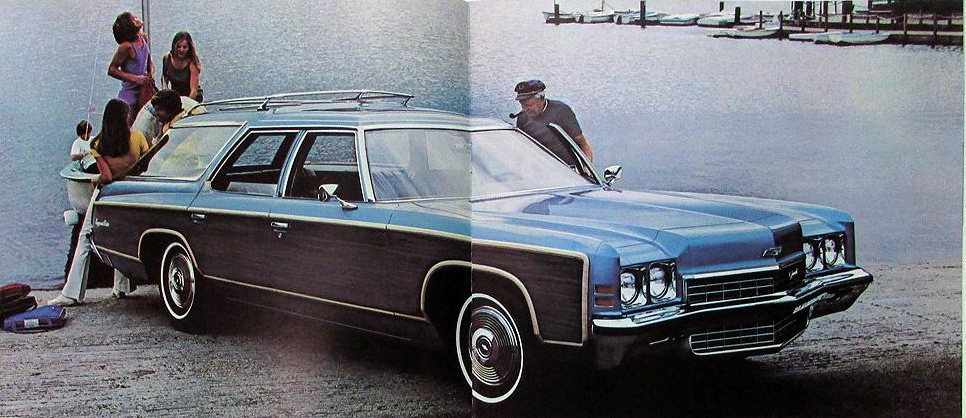
The front seat was a bench seat, meaning that it was one continuous expanse of faux leather from the driver’s side door to the curb. You have to think that it could move back and forth to accommodate differently sized pilots, but the procedure must have required some kind to winching system to lug the pew forward. Whatever the procedure, I remember that there was enough room left for my head to fit on my mother’s lap between the steering wheel and her stomach. I can remember lying on the bench seat with my feet toward the passenger’s side and my head resting on my mother’s legs while she drove with one hand and stroked me hair with the other.
Do not fear, gentle reader, this is not a post about how my generation is uniquely prepared for the times we are facing because we drank out of the garden hose. We did drink out of the hose and maybe we are better for it, but that’s not the point. The point is that, as the youngest of four children, I don’t recall a whole lot of moments when it was just me and my mom, times when she could give her attention just to me. Arguably, with her responsibility to her passengers as well as the other cars on the road, my mother’s attention at a moment like this should have been, if it was not actually, at best divided between me and driving. Honestly, it probably should have been all on driving, but I did not know or care about that.
To be honest, I still don’t. Given the opportunity to lay down on the front bench seat of a Kingswood Estate and place my head in my mother’s lap as we hurtled down the road in at least two tons of steel and wood veneer, I would take that offer in a heartbeat. In a sudden departure from our Chevroletian heritage, our family replaced that car with a Volkswagen pickup truck well before I could drive. Being a stick shift with bucket seats, the VW was not conducive to having one’s head cradled by the driver. My head had probably grown too big for that anyway.
I had not grown too big to want the particular, if not exclusive, attention of my mother. What child does? A dear friend recently lost their father, and I was reminded again of the peculiar grief that comes with the death of a parent. Unless something goes terribly wrong, we assume that all children will outlive their parents, and still, each child experiences the death of their parents uniquely. Maybe my siblings laid their heads in my mother’s lap as she drove, but as far as I know, I am the only one who did that. There is a particular, if not exclusive, way that I experienced the attention of my mother because she was paying attention to me.
No one else will quite be able to do that in the way she did. I can’t even describe fully how she did it or what it felt like, other than to remember the warmth of the bench seat beneath me and the gentle rocking of the land yacht as my mother’s fingers combed my hair. And the truth is that I lost much of that feeling long before she died because my mother was every bit as much a human being as any person I know (but also because my head got too big).
Still, I am grateful to have laid in the presence of that feeling and to have lived in its absence. I’m grateful for the latter because there is room in that absence to share with a dear friend who is now feeling a loss. There is room in the absence to hold memories of my mother without needing her to be anyone but who she was. Telling the truth about what we have lost gives the space it has left empty the opportunity to be that void over which God’s spirit moves to begin creating.